Chapter 1
The Most Boring Morning in the World
Home
“Nice cup of tea, Paul?” his mother called from the kitchen.
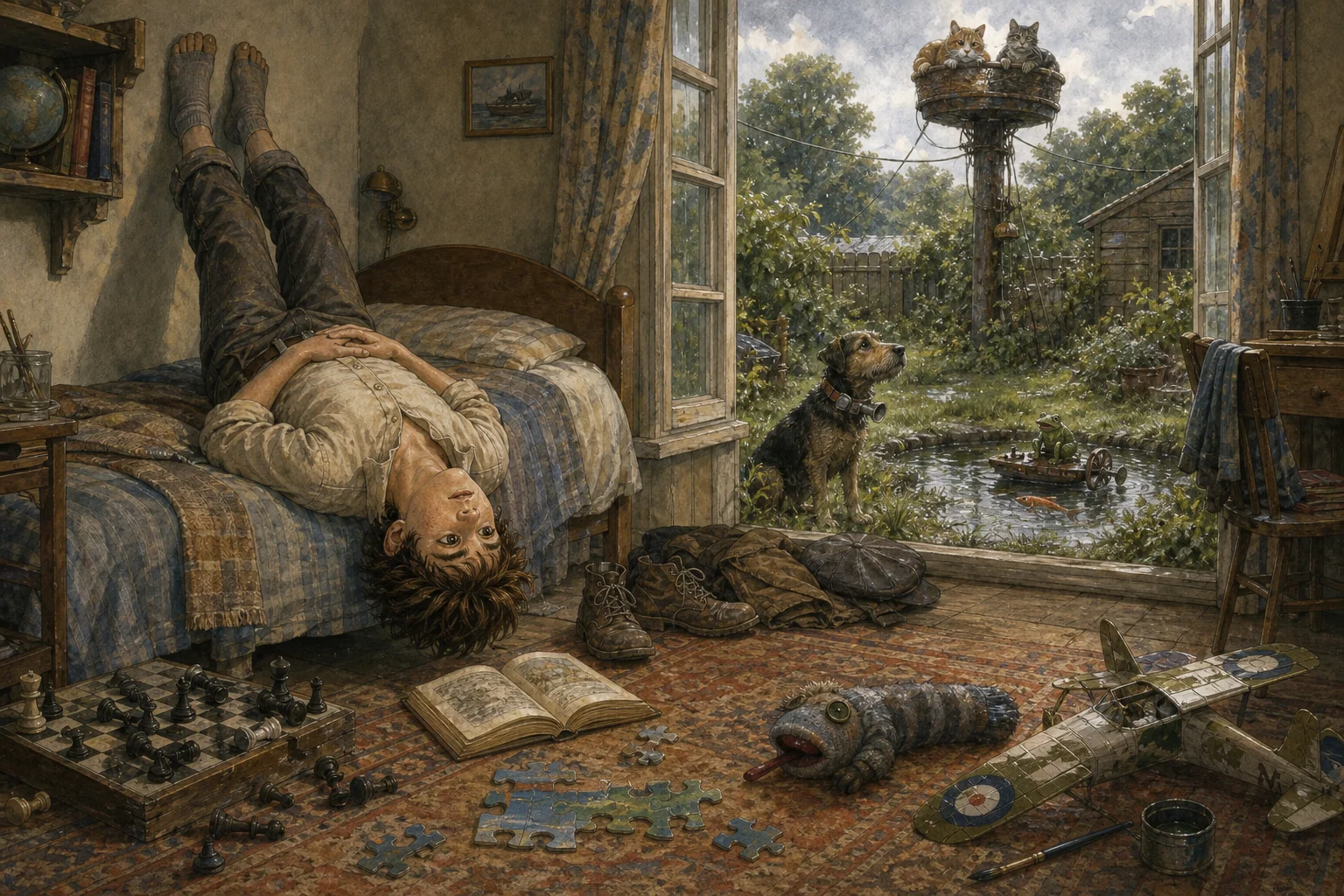
Paul lay upside down on his bed with his feet against the wall. Around him were the remains of fourteen abandoned activities.
There was a book open at page six, a jigsaw with three pieces joined together, one sock from a puppet he had started making, a half-painted model aeroplane, and a chessboard on which every black piece had apparently surrendered.
“Yes, please, Mum!”
Paul let his head hang over the side of the bed and stared at the carpet.
“I’m bored,” he told it.
The carpet did not answer.
“Bored, bored, BORED!”
His boredom was not the peaceful sort. It buzzed in his head like a bluebottle trapped against a window. Books were interesting until they became slow. Games were exciting until he learned how they worked. Walks were pleasant until he had seen everything there was to see.
Only inventing could hold him for long.
For Flossie the dog he had made a collar containing a tiny loudspeaker. If Flossie wandered too far, Paul’s father could call, “Come home!” into a microphone and the command would follow her across the fields. The difficulty was that every other dog who heard it came home too. One Tuesday, twelve puzzled dogs arrived in Paul’s kitchen before lunch.
For Muggy and Moggy, his mother’s cats, Paul had carpeted an old telegraph pole and fixed a basket to the top. The cats called it home. The villagers called it the Cats’ Cradle. Paul’s father called it a menace to aviation.
For Jumpy the frog, Paul had built a floating platform with a motor and propeller. Jumpy could cruise around the garden pond while Ginger the carp swam beneath him looking deeply unimpressed.
Paul liked problems because problems had answers. Boredom was different. Every answer he tried became another part of the problem.
He slid off the bed, paced across the room and clasped his hands behind his back. This was how he did his best thinking.
“Perhaps,” he said, “I have been trying too hard not to be bored.”
He stopped.
“What if I did the most boring thing in the world? Everything afterwards would seem exciting by comparison.”
At that exact moment Mr Rowe the builder jogged past the bedroom window. His face was the colour of beetroot. His cheeks puffed in and out, his knees knocked from side to side, and every step appeared to cause him great personal disappointment.
Paul pointed.
“That’s it! Jogging! You put one foot in front of the other, then do it again hundreds of times. It is perfect!”
He charged into the kitchen, nearly knocking his father’s bacon sandwich out of his hand.
“What’s the hurry?” his father asked.
“I’m going jogging.”
His parents looked at him.
“Jogging?” they said together.
“It is an experiment. I shall become so bored that ordinary life will feel magnificent.”
Paul took half his father’s sandwich, dipped it in brown sauce and washed it down with his mother’s tea.
“Thanks. Excellent fuel for scientific research.”
Outside, a helicopter from the nearby airbase thudded across the sky. Paul ran to the window and flashed sunlight at it with the little signal mirror he kept in his pocket.
“Don’t do that,” said his father. “The pilot will think we need rescuing.”
“You never know when a person might,” Paul replied.
He found an old cap and a pair of muddy shoes, picked up a rather defeated banana, and headed for the door.
“You haven’t combed your hair!” his mother called.
Paul dragged his fingers through it.
“Done!”
He jogged past the pond, saluted Jumpy and Ginger, called goodbye to Muggy and Moggy, and set off towards the fields.
He intended to have the dullest morning of his life.
Instead, he found the end of a rainbow.